We can all come to an agreement on one fundamental truth: programming is essential for proper, measurable, and repeatable growth.
However, the term “program”—and specifically the act of writing one—has become a buzzword that is frequently overused and rarely understood with the seriousness it deserves. A true program is not just a list of movements; it is a comprehensive strategy that is well thought-out, meticulously planned, and executed in a manner best suited for the specific individual it is meant for.
Fundamentally, a program must possess structure and purpose. Without these two pillars, you cannot claim to be writing a program; you are merely writing workouts. While jotting down a workout simply takes time, designing a legitimate program demands time, effort, and deep thought. And honestly, it’s okay to say that you just write workouts for your clients.
I have been a personal trainer/coach for 10 years. Throughout the years, I have worked at multiple styles of gyms: big chain gyms like Club Fitness, D1 Sports Training, multiple CrossFit gyms, and even the premium LifeTime Fitness. To be honest, most of the clients I had at those gyms didn’t necessarily need a program. They needed to be shown that they were being paid attention to and given feedback on how to perform the exercises correctly, so as not get hurt.
I’m sure I might get a lot of criticism from many trainers by stating that I didn’t write out elaborate programs for some of my clients, at least not in the beginning.
It wasn’t about laziness; it was about learning the balance of investment. I had to ask myself: Am I going to be 100% all-in on designing a complex 12-week cycle when I still need to learn the commitment and investment of the client? If a client is inconsistent, skipping sessions, just going through the motions, or looking for the next best thing, handing them a rigid spreadsheet doesn’t help them—it overwhelms them. They don’t need periodization yet; they need consistency. Until I understand their level of investment, a simple, well-structured workout is the most effective tool I can give them.
Hear me out. First, if you are a trainer, how many times have you sat down and actually written out a plan for your clients? Not workouts. Writing plans or “programs” for our clients is what we are taught to do, isn’t it? In order to display to our clients and other trainers around us how caring we are, how thoughtful we are, and how great a trainer we are, we must design elaborate programs, right? And we also go crazy over other trainers or coaches’ “programs,” don’t we?
The “Qualified” Trap
Let me tell you about my first year as a trainer, back in 2014. I started as a trainer at a club fitness. I spent hours creating templates and writing out “individualized” workout plans for my clients. Just in case you were unaware, when you start as a trainer, there usually is a lot of downtime, and I spent that time creating templates. I am confident to say that I was probably one of the only trainers to actually spend the time doing this.
It makes sense because I was still in school, studying Exercise Science, so it would be honorable of me to show off the skills that I have been learning in school. It wasn’t just about applying what I learned in school; if I’m being honest, there was an element of ego involved. I wanted to show the other trainers on the floor that I was more ‘qualified’ than them. I wanted to prove that I could articulately plan out a client’s training in a way that looked professional—at least, professional in my eyes. I spent hours making cool-looking spreadsheets, planning out the periodization and the structure, convinced that this level of detail was what separated the experts from the amateurs.
Well, I’ll tell you what: I can confidently say that all that work paid off to… very little to no results of new clients actually signing up with me. My clients didn’t care, and the leads didn’t care. Maybe the trainers cared a little bit, but they are not the ones going to pay for training.
The Reality of the Industry
However, I’m not saying that planning exercise programs is a complete waste of time, but what I ended up learning—and still believe to this day—is that many of the most ‘successful’ trainers usually fall on one of two ends of a spectrum. Neither of these trainers uses up their time writing exercise programs for their clients.
- The Seasoned Vet: These are just honest people who genuinely care for their clients. They aren’t wizards at exercise programming or nutrition experts, but they have been in the gym for a long time. They produce results simply because they are trustworthy, consistent, and make people feel comfortable. They are successful simply because they have been in the game for a long time and have learned how to best work with different types of people.
- The Salesman: These trainers talk a big game. They know how to ask the right questions to get a ‘yes’ and sign people up on a dream, but they rarely follow through with a great product. They often have all their clients do roughly the same things, copy-and-pasting workouts while holding tight to a few random success stories to close the deal. They see each client as a dollar sign and are motivated only by stacking those dollar signs up.
The “Perfect Template” Reality Check
Alright, let’s say you don’t fall on either of those extremes. Let’s say you are the smart, efficient trainer who is honest, genuine, and deeply cares about your clients. You are the trainer who is prepared. You already have multiple workout templates built out so you can easily assign a well-developed program to a client with a goal that matches the template you took the time to design.
Great! You have created a system that works for you! You are ahead of the game and working smarter, not harder.
But, I want you to answer these questions honestly for yourself:
- The Modification Reality: How often did you have to change, modify, or adjust the exercises—or even the sets and reps—of that template? Because you are an honest and caring trainer, you likely realized that some of the prescriptions in that template didn’t actually match the goals, mobility, movement patterns, or even the preferences of the human being in front of you.
- The Compliance Reality: What percentage of clients have actually followed through with said program template for the exact number of weeks and days you wrote it out for? What happens when they end up missing a day, a week, or even a month?
These things happen, and they happen more often than you think. Do you just push the workouts back a week? Well, sometimes you can. But other times, life gets in the way. You might have to plan a lighter re-entry week or even change the program altogether. I’ve had to do this many times when a client has gotten injured or life has gotten too busy, just to appropriately work them back up so they can return to their normal capacity.
When To Write a Full Program
Now, let’s talk about my approach to writing a fully individualized workout plan and how I decide if a client meets the requirements for one. First and foremost, we must adhere to the rule that every program must be structured, have a purpose, and be assigned to a specific goal. But before I invest the effort to design that, the client must show me some type of commitment.
Initially, this usually appears as a logistical commitment, such as the number of sessions they purchase or a time agreement of 3, 6, or 12 months. To be clear, this isn’t just a ‘money thing’; it is a necessary display of buy-in on their end.
However, sometimes a client can simply tell me about their fitness journey and plan, and if the intent is there, I am already bought in. For example, I once had a potential client walk in the door and hand me a complete body profile—Dexa scan results included—telling me their specific goal was to improve their bone density. I was ecstatic. You better believe I was smiling from ear to ear, because I could tell immediately that they had done their research. They understood fitness on a level deeper than just aesthetics; they had a specific, physiological goal. Conversations like that create instant trust between the client and me. It is very easy for me to trust someone with a comprehensive program when they come to the table with that level of seriousness.
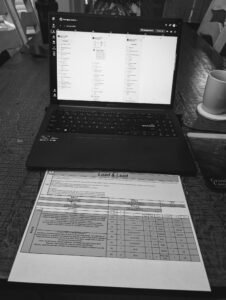
A Practical Approach: The Bare Bones Template
Most often, when I ask myself if a client needs a developed program, I come back to one of the most common answers: ‘It depends.’
It depends on how invested the client is. It depends on how willing and capable they are to follow a complete plan. And even if I know they are committed, it depends on what I learn from meeting them on Day 1.
I would argue that before designing any long-term program—even for a committed athlete—the best method is to start with a Foundational Plan. This is a basic phase lasting a few weeks that allows you to get a feel for the client before locking them into a longer 8–12-week cycle. During this phase, I use common and usually familiar exercises to determine how I am going to best approach the more individualized program, and I am looking for specific data points:
- Preference: What movements do they seem to enjoy most? Enjoyment is a top priority for adherence.
- Buy-In: Do they trust the process? You might think they ‘need’ to do Power Cleans because pro athletes do them, but if they hate them or don’t see the value, the program might not be utilized to its highest potential.
- Progress-ability: Which movements look like they can be loaded and progressed safely?
- Necessity: Do they need to learn how to squat properly before they can perform a lunge? Do they need depth drops because they struggle with landing mechanics?
- Realistic Availability: You might have a template for 2 days a week, but they want to train 4 days (2 with you, 2 on their own). And don’t forget the lifestyle factors—if they play 2 hours of competitive pickleball every weekend, your volume needs to account for that.
With all those factors in play, rigid templates become a trap. They are good starting points, but they cannot be the end of the process.
My proposed solution is to design ‘Bare Bones Templates’—frameworks that are specific enough to have a goal, but flexible enough to be adjusted for the human being in front of you. Now, let me first state that this is not a ‘cure-all’ to program design; this is just one way to maintain versatility in your programming and make the process less cumbersome.
When I say ‘Bare Bones,’ I don’t mean just listing a Squat and a Push-up. I mean, defining the structural rules of the program. Exercises can be swapped out based on equipment or injury, but the structure must remain intact to drive the specific adaptation.
Here is the checklist you can use when designing the structure of these templates:
- The Phase Goal (The “Why”)
Before you pick a single movement, you must define the phase. Are we in an Accumulation Phase (building work capacity and volume)? Are we in an Intensification Phase (increasing load and lowering volume)? A Realization Phase (peaking for performance)? Or is this a Deload/Recovery Phase? If you don’t know the phase, you don’t have a program.
- Periodization Style
How will the weeks progress?
- Linear: Simply adding weight or reps week over week? (Great for beginners).
- Undulating: Varying the rep ranges and intensity throughout the week (e.g., one heavy day, one volume day)?
- Block: Maintain a strict focus on one quality (e.g., hypertrophy) for 4-6 weeks before switching phases. Although this can feel repetitive, the simplicity ensures the client knows exactly what the goal is.
To be honest, most programs may involve a blend of these styles. An undulating program will likely be linearly progressed from week to week and will usually have a focus on hypertrophy, strength, or endurance.
Visualizing the Difference: A Typical Programming Layout
To give you an idea of what I mean by “structure,” here is a look at a typical programming layout based on percentages of a 1-Rep Max (1RM).
| Week 1 | Week 2 | Week 3 | Week 4 | ||||
| Day 1 | 78% | Day 1 | 80-83% | Day 1 | 75% | Day 1 | 88% |
| Day 2 | 70% | Day 2 | 70% | Day 2 | 70% | Day 2 | 70% |
| Day 3 | 80% | Day 3 | 85% | Day 3 | 80% | Day 3 | 90% |
Of course, you can also use RPE (Rate of Perceived Exertion) or RIR (Reps In Reserve) to display the intensity you want to get out of the client. This is often more practical for general population clients where daily strength fluctuates:
|
Week 1 |
Week 2 | Week 3 |
Week 4 |
||||
|
Day 1 |
RPE 7
3 RIR |
Day 1 | RPE 8
2 RIR |
Day 1 | RPE 5
4-6 RIR |
Day 1 | RPE 9
1 RIR |
|
Day 2 |
RPE 6
4-6 RIR |
Day 2 | RPE 6
4-6 RIR |
Day 2 | RPE 6
4-6 RIR |
Day 2 |
RPE 6 4-6 RIR |
|
Day 3 |
RPE 8
2 RIR |
Day 3 | RPE 8.5
1-2 RIR |
Day 3 | RPE 7
3 RIR |
Day 3 |
RPE 9.5+ Max Effort |
Using this method allows for auto-regulation. If a client didn’t sleep well or is stressed, “RPE 8” might be a lighter weight than last week, and that is okay. The effort remains structured, even if the load changes. This ensures they are working hard enough to stimulate adaptation without strictly needing a calculator.
The Method Behind the Numbers
Although the intensity on Day 2 didn’t change throughout the weeks, the overall weekly intensity increased. You could argue this is a form of linear progression, but it is nuanced by varying the intensities on specific days.
Usually, this type of structure is planned for programs training a specific outcome, such as a Squat/Bench/Deadlift for Powerlifting or Snatch/Clean & Jerk for Olympic Weightlifting. In these sports, the lifts you perform in competition are the priority. You need lower intensity days (like Day 2) to avoid burning out the athlete, allowing for maximum potentiation on those higher percentage days.
It is a specifically articulated approach to linear periodization. This undulating style is also used for other non-lifting sports, such as long-distance running or swimming, where you have your long-distance days distinct from your interval or sprint days.
- Intensity and Volume Prescriptions
This is where the magic happens. A squat is just a squat, but a squat performed at RPE 8 for 5 reps is a strength stimulus, while a squat performed for 3 sets of 15 is a metabolic/endurance stimulus. Your template must define the intensity (RPE, RIR, or % of 1RM) and the volume (total sets/reps) required to meet the phase goal. All you need to do is determine what intensity you want the client at with the prescribed volume.
- The Split (Frequency)
How is the work distributed? Is this a Full-Body split? Upper/Lower? Push/Pull? Hinge/Press? This depends heavily on the client’s frequency (2 days vs. 4 days), goal (e.g., wanting a 225lb bench), and preference (e.g., they get unmotivated when they hear “leg day”). However, the structure must ensure they are hitting the necessary muscle groups often enough to stimulate growth.
- Rules for Progression
This is slightly different than the periodization style (focus). This answers the question: How do we move forward in the next cycle? A program must have a rule for progression.
- Are we just increasing the load (weight) while dropping volume?
- Are we adding tempo?
- Are we decreasing the rest time?
- Are we moving to a more mobility-focused phase?
- Are we putting more emphasis towards warm-up and cool-down to help with recovery?
If there is no plan for progression, it’s just maintenance.
The Final Structure
Once these variables are set, the “exercises” become interchangeable variables within the structure. A solid Bare Bones Template looks like this:
Phase: Accumulation (Weeks 1-4)
Split: Upper/Lower
Main Metric: Volume (Sets x Reps)
Primary Intensity: RPE 6-7 (leaving reps in the tank)
Progression: Add Tempo in the next cycle/phase.
From here, you can make the template as fancy or as simple as you want. What matters is that you now have a shared roadmap—a tangible guide that ensures both you and the client are aligned on the path forward.
The Discovery Phase and Ethical Assessment
Even with a template in hand, you have to accept the reality of adherence. I can count on one hand the number of clients who were able to follow a program to its fullest without illness, injury, or life simply throwing them off the plan. Ultimately, you want to have a plan, but you must be ready to work on the fly. You might be changing the program slightly every week, or even every session, until you figure out what truly works for them.
For most of my clients, the first 3-6 sessions are really just a ‘Discovery Phase.’ Like most trainers, I have a traditional warm-up that I have everyone follow to give me a clear picture of their movement capabilities—simple patterns like a squat, lunge, push-up, and row. But there is a crucial distinction in how I handle this: Cue, then Assess.
Never assess a client without first showing and telling them how to perform the exercise correctly. Doing so is wrong and, frankly, manipulative. It’s a tactic used to make clients feel ‘broken’ so they buy training. The truth is, most people actually have a decent squat once I correct a few fundamental issues like feet turning out or the chest falling forward. They usually can hit below parallel; they just aren’t confident in it yet.
On that note, I have to be honest: I really dislike the Overhead Squat as an assessment for the general population. You are just setting them up for failure. I am an Olympic Weightlifter—this is my sport—and even I have issues with the overhead squat until I have had 5 to 10 minutes to warm up properly. To take a cold Gen Pop client, put a bar over their head, and tell them they need training because they can’t hit a perfect bottom position is ridiculous. Stop setting your clients up for failure just to fill in the blank on a sales sheet.
The Client Perspective & The Integrity Trap
Now, I want to speak directly to the clients for a moment. If you are a client, how much do you actually care if a program is physically written out for you? Do you even understand what that really means?
You might have cared during your introductory session when the trainer told you they would build a ‘customized program just for you.’ That promise adds value; it justifies the price tag. And yes, I understand that personal training is a significant financial investment. However, I believe the true value of personal training doesn’t come from the piece of paper or the spreadsheet; it comes from the attention, education, and correction the trainer gives you during the session.
Here is a dirty industry secret: Trainers often say they have a ‘personalized’ program written out, but many are either using a template or writing the workout the day of the session. I am guilty of this, too. But there is a crucial difference: even if I write a workout the day of, there is always an overarching goal for that client, and the workout is written in strict accordance with that goal.
However, there is a dark side to this. I will never forget my first personal training job at Club Fitness. One of the other trainers told me, ‘I have to write my next client’s “program”.’ I watched them open up CrossFit.com and blindly copy whatever the Workout of the Day (WOD) was. I was shocked. I never thought a professional would do that… but that is the fitness industry.
If you are a trainer reading this and all you are doing is copying and pasting a workout from another site, Shame on you. Sure, the client might sweat, and they might even progress for a bit. But where is the integrity in that? How long will that last until something goes wrong? How long until they get injured because they can’t perform a high-skill exercise, and you have no idea how to modify it because you didn’t actually design it?
Ultimately, whether you are just writing workouts or designing elaborate programs with goals attached, make sure you are balancing the investment see-saw. Give your client the most they can handle, but keep yourself sane by not overloading yourself with mundane work.
Real coaching isn’t about finding a cool workout or destroying your clients till they can hardly walk the next couple of days; it’s about leading a client safely toward their specific goal.